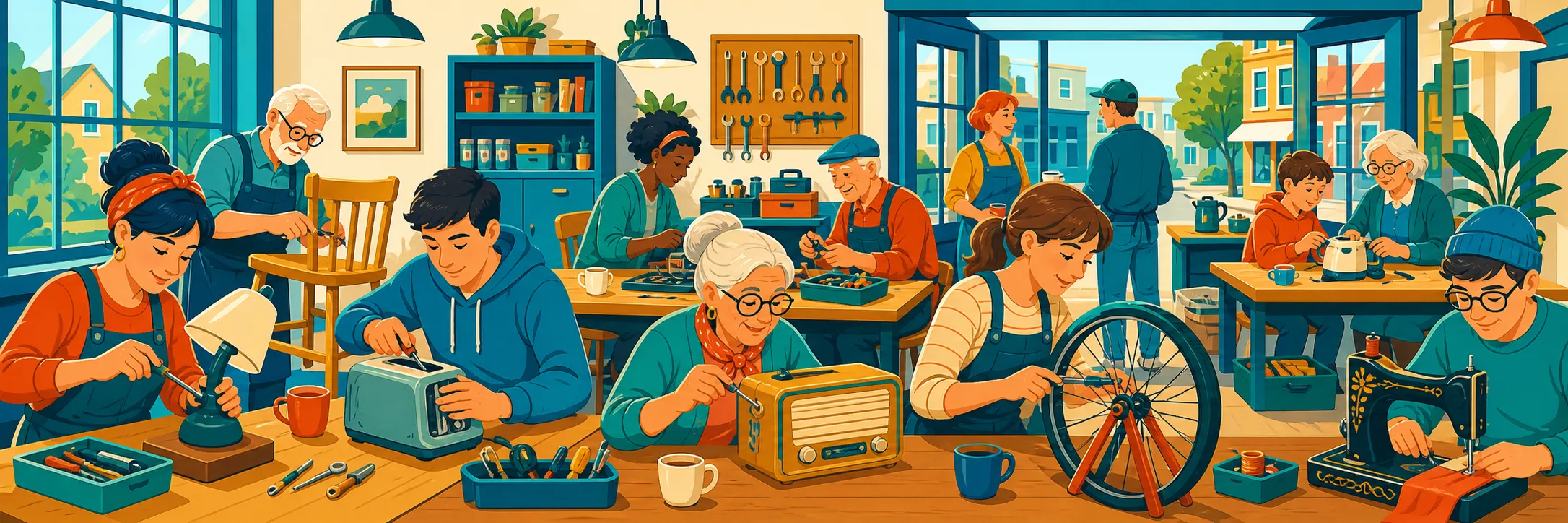
In a lot of towns, once a month or so, people carry their broken things into a borrowed hall and other people fix them for nothing. That is a repair café, and it is a real thing in the real world, not something I made up for a book. A church basement or a library meeting room. A dozen volunteers with their own tools. A coffee urn going in the corner, and a line of toasters and lamps stacked by the tables.
The most cheerful rooms I know
I go to these when I can find one, and they are among the most cheerful rooms I know. Somebody's kettle gets a new cord and works again, and the person who brought it in grins as though they have gotten away with something. The volunteer grins back, because fixing a stranger's kettle in ten minutes is a genuinely good hour of a Saturday. Nobody is selling anything. That is most of the charm of it.
The town in the book
In the town I write, the monthly repair café is run by the high-school shop class. Sixteen-year-olds at the tables, with the older hands of the town standing behind them to catch what goes wrong. That is the setup of Fixed to Death, my first novel, and of the books meant to follow it. It gave me a room where the whole town shows up with its private business in a cardboard box, and a reason for my sleuth to be standing right there when it does.
What the kids bring
The kids are good at it, better than most adults expect them to be. They have no fear of a screw. If a thing has eight screws they take out all eight, where a grown man will try to work around six and strip the last two. They learn fast. And the learning runs both ways, because the old fellow watching a sixteen-year-old open up his drill remembers doing it himself at that age, and tells the table about it, and the lesson takes on both sides of the counter.
Why it suits a mystery
A town that fixes its own things in public is a good place to set a mystery. Once a month the whole town's broken belongings cross one counter, in one room, in front of everybody. A toaster carried in by a neighbor is a small piece of that neighbor's month, and whoever repairs it gets to read the piece. My sleuth did not have to snoop to see everyone's private life. I gave the town a repair café and put her behind the counter, and the town brings it all to her.
That is most of why I set these books in a repair café and not, say, a diner. A town that repairs its things in public writes down more than it means to, in tickets and sign-in sheets and the memory of everybody who was in the room. I get to be the one who reads it back to them, a month or a year later, when it turns out to matter.