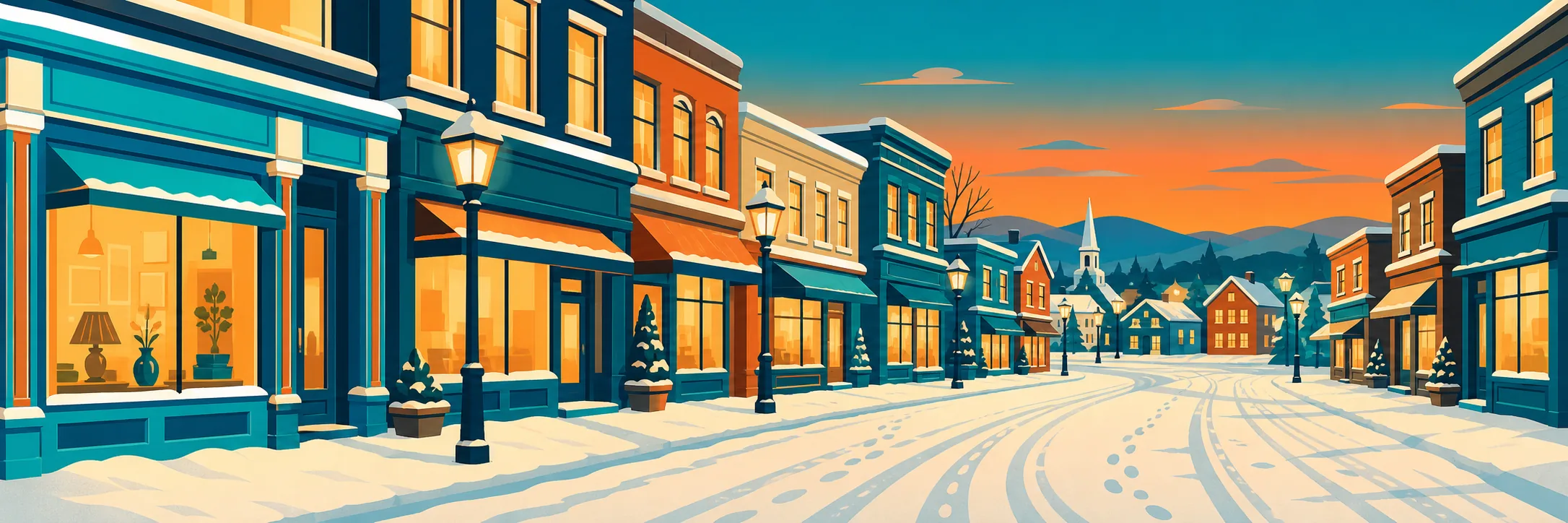
The clocks went back on Sunday, and up here on the Sound the dark comes down at half past four now. It is the week the first strings of lights go up on porches, early, before anybody has quite admitted it is time. I have spent the week thinking about the town I made up, and about the lights it used to have.
Poles
Gault Mills is a mill town in the Pacific Northwest, invented for the mysteries I write, and its main street runs a block up from the river. For a good many years that street was lit for Christmas end to end. Strings ran pole to pole down both curbs, heavy commercial strings with cloth-braided cord and lamps the size of a thumb. Flat frames bent from steel rod rode the strings, candles and snowflakes, the paint touched up every few years. Over the crossing hung the big frame, the one piece a person could see from the far end of Main. The display was large enough that the utility crew hung it, from a bucket truck, a pole at a time.
The first Saturday
It went up on the first Saturday in December, and the whole town turned out on Main for the lighting. The diner stayed open late so that people could stand in the cold with their coffee. I grew up near towns on the Oregon coast that did exactly this, and I remember the order of it well. The display went on, and then everything else in December arranged itself around the display. The church hung its greens the week after, and the school put its concert on the calendar after, because the lights came first.
Ten years dark
Ten years ago a lineman died working on the display in an ice storm. The county ruled it an accident. The town has told it that way ever since, and the lights have not been up since. Nobody voted to stop, because stopping is not a thing a council votes on. The display simply did not go up the next year, and the whole display went into crates, strings and frames and all, and the crates went into storage and stayed there. A wreath goes up on one pole every December. That has been the display for ten years.
A dark December
What a small town does with that kind of December is what people do with any loss. It fills in around the edge of it. The co-op puts a small string of lights over its door. The church hangs its greens. A wreath appears on a door here and there along Main, and the diner has a tree in its window by the second week. None of it is the display, and everyone knows it is not, and nobody says so out loud.
The vote
My second novel begins with that town voting to put the lights back up. Dead Short arrives on November 14, and the story is set in the December that follows, Connie Sadler's second Christmas in Gault Mills, when every crate of the old wiring comes to her bench to be passed or condemned before a switch gets thrown. What she finds in the crates is the book's business. It arrives in eleven days, and it can be pre-ordered on Kindle now.
The porches up here will be lit by the weekend. I will probably walk out under them in the rain, thinking about a street where the poles went dark and stayed that way, and about what it costs a town to hang the lights again.